The AI Paradox: Why Coding Faster Can Slow Down Your Deliveries
Your team is generating 40% more pull requests since they started using an AI assistant. The review backlog has doubled. Cycle time on main has not moved. The problem is not the AI — it is that your delivery system was sized for human writing speed, and that speed just changed.
+55% on isolated tasks, −7% on main
Section titled “+55% on isolated tasks, −7% on main”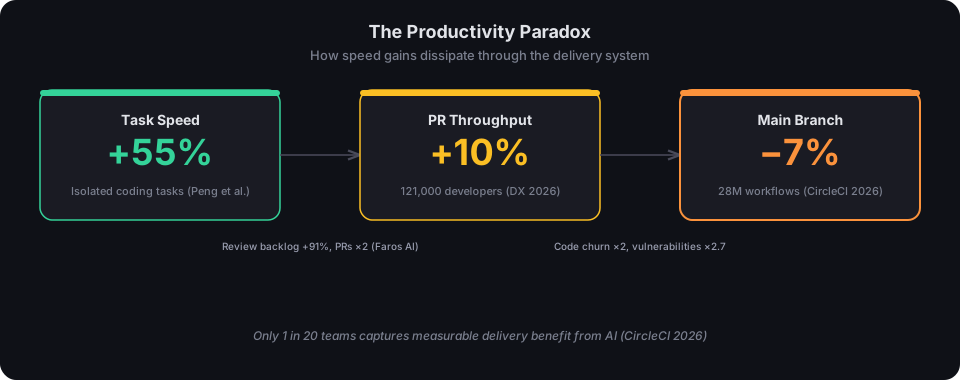
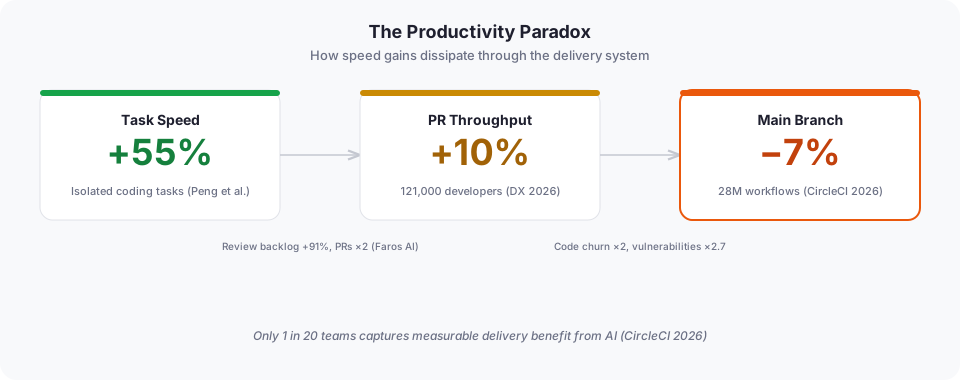
The GitHub Copilot study (Peng et al., 2024) measures a 55% gain on isolated development tasks. The number is real. But when DX analyzes 121,000 developers in real-world conditions (2026), PR throughput increases by only 10%. And CircleCI, across 28 million workflows, finds that throughput on main branch dropped 7% despite a 15% increase on feature branches.
I have seen this pattern in three organizations last year. The productivity dashboards are green, developers are producing more code, and lead time to production has not moved. The local gain does not make it past the delivery system’s front door.
CircleCI puts a number on the result: only 1 team in 20 captures a measurable delivery benefit from AI. For a team of 50 developers with unoptimized AI workflows, CircleCI estimates delivery costs at roughly $900,000 per year. Generation speed without adapted infrastructure costs more than slowness. For a framework on measuring whether these gains translate to real ROI, see Measuring AI ROI: Stop Counting Speed, Start Counting Cost Per Task.
Review has become the limiting factor
Section titled “Review has become the limiting factor”When code volume doubles, someone has to read it. Faros AI measured this reality across 22,000 developers (2026): PR volume up 98%, average size up 154%, review time up 91%. And 31% of PRs are merged without any human review.
Daniel Stenberg, curl maintainer, sums up the mechanism: “AI doesn’t increase the capabilities of the humans in the loop. It shifts the cost to review.”
Review capacity is finite. You cannot scale it as fast as code generation. When you bypass it by merging without review or approving out of fatigue, you are not saving time. You are borrowing debt that you will repay in incidents.
Faros AI quantifies the bill: incidents per PR increased by 242%. For every merged change, the probability of a production incident tripled. A Carnegie Mellon and Stanford study of 802 developers and 196,000 PRs confirms the mechanism: the company studied achieved 2.09x throughput per developer, but review load doubled in exact proportion. The upstream gain was absorbed by the downstream verification cost.
AI-generated code carries a hidden bill
Section titled “AI-generated code carries a hidden bill”Volume is not the only problem. The quality of generated code creates a downstream cost that writing speed does not compensate.
GitClear analyzed 211 million lines of code between 2020 and 2025. Code churn doubled (from 3.3% to 7.1%), refactoring was cut in half (from 24% to 9.5%), and intra-commit copy-paste quadrupled. 2024 is the first year where duplicated code exceeded refactored code in commits. AI generates throwaway code faster than before.
On the security side, Veracode tested over 100 LLMs across four languages (2025). Result: 45% of generated code introduces OWASPOpen Web Application Security ProjectA nonprofit foundation that produces standards, tools, and guidance for application security, including the OWASP Top 10 vulnerability rankings. Top 10 vulnerabilities, 2.7 times more than human-written code. The failure rate in Java reaches 72%. And Snyk (2024) reports that 80% of developers believe AI produces safer code. Every empirical study says the opposite.
I think this is the most underestimated risk of AI adoption. A developer who trusts output they did not write reviews less carefully. Generation speed creates an illusion of control that disables the verification reflex.
The 5% who succeed had already invested
Section titled “The 5% who succeed had already invested”DORADevOps Research and AssessmentA research program that measures software delivery performance through four key metrics: deployment frequency, lead time, change failure rate, and recovery time. 2025 describes AI as a “mirror and multiplier.” It amplifies the existing system, in both directions. Teams with a good system deliver faster. The rest accumulate more debt, faster. I propose a decision framework for identifying these initiatives in Where Does AI Actually Create Value?.
CircleCI confirms this with pipeline data: teams that had CI under 15 minutes in 2023 are five times more represented in the 99th percentile today. Past investment in delivery infrastructure is the best predictor of AI success — not tool adoption.
Kent Beck puts it differently: “90% of my skills are now worth $0… but the other 10% are worth 1000x.” The 10% that matter are architectural judgment, verification capability, and design. What AI does not replace, and what your delivery system must protect.
The good news: DORA identifies a J-curve. The stability drop is temporary. But recovery only comes if you invest in the system during the dip, not after.
Adapt the system, not the tool
Section titled “Adapt the system, not the tool”Four levers I have seen work.
Limit PR size. SmartBear and Cisco show that defect detection drops beyond 400 lines. When AI produces 800-line PRs, enforce a ceiling. A change too large to review is too large to merge.
Automate gates, not review. Tests, linting, SAST, dependency analysis: everything a machine can verify should be verified before a human opens the PR. GitHub Copilot Code Review (60 million reviews in March 2026) shows that AI-assisted review works as a complement. The human decides on design and intent. The machine verifies compliance.
Plan review capacity. If your team generates 40% more code, you need 40% more review time. Not 40% more developers. Protected time in sprint planning. Review is production work, not a side task.
Deploy progressively. Canaries, feature flags, observability-driven rollouts. DORA 2025 shows these practices correlate with elite performance. They absorb the risk that generation speed introduces.
Take the next AI-generated PR that exceeds 400 lines. Measure the time between its opening and its merge. Compare it to the same team’s time six months ago. If the delta is positive, the problem is not your developers’ productivity. It is your delivery system’s capacity. Start there.