Where Does AI Actually Create Value? A Decision Framework for Technology Teams
Forty-six percent of AI proofs of concept never reach production. Not because the technology failed, but because the business problem was not specific enough, the data was not clean enough, or the real cost was never calculated. If you are steering technology investments, that number is not inevitable. It is the symptom of a decision made without a framework.
I will say it directly: launching an AI project and creating value with AI are two different activities. The PwC 2026 Global CEO Survey, covering 4,454 CEOs across 95 countries, confirms the scale of the disconnect: 56% report neither revenue increases nor cost reductions attributable to AI. The problem is not AI. The problem is what happens before the first commit.
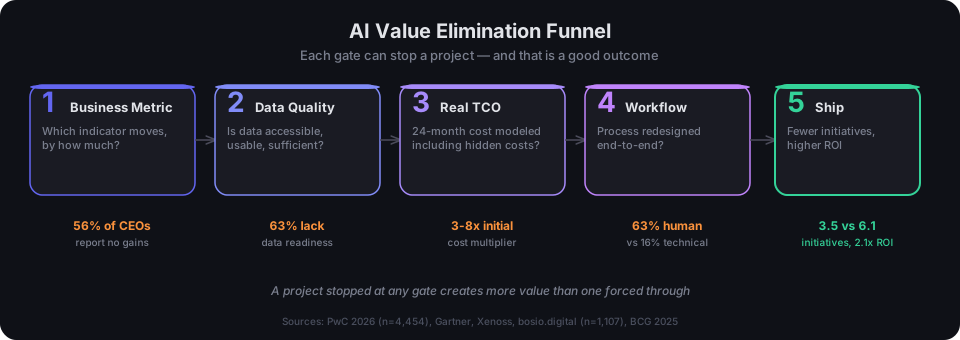
I use five criteria as an elimination funnel. Each one can stop an initiative. That is the point: stopping a project that will not pass these filters creates more value than launching it.
Fewer projects, more value
Section titled “Fewer projects, more value”Intuition says the more AI initiatives you launch, the better your odds. The data says the opposite.
BCG measured the gap in 2025: organizations that capture the most value from AI run an average of 3.5 initiatives, compared to 6.1 for the rest. Their ROI is 2.1 times higher. This is not a paradox. It is resource allocation. Every AI project consumes management attention, engineering time, and data bandwidth. Spread those resources across six projects and you get six mediocre prototypes. Concentrate them on three and you have a shot at reaching production.
The trend is accelerating. S&P Global reports that 42% of companies abandoned most of their AI initiatives in 2025, up from 17% the previous year. I have seen this dynamic play out in organizations I work with: the first wave of enthusiasm produces a catalog of POCs; the second wave sorts through the wreckage. If you sort before spending, you come out ahead.
No business metric, no project
Section titled “No business metric, no project”The first question for any AI project sponsor is not “which model?” or “which platform?” It is: which indicator moves, by how much, in what timeframe?
Without a measurable baseline, you cannot know whether the project succeeds or fails. You can ship a performant model, a clean pipeline, a convincing demo, and have zero idea whether it moved anything that matters.
The UK Cabinet Office shows what clarity produces: GBP 480 million in fraud prevented or recovered through government AI. The problem was specific (benefits fraud), the metric existed before the project (fraudulent amounts detected), and the delta was measurable within the first quarter. IBM Watson Health took the opposite path. Massive investment in oncology over years, sold off in 2022. The ambition was immense. But the distance between the promise (“revolutionize diagnosis”) and an operational metric (“reduce false negatives by X% for this cancer type”) was never closed.
In my experience, when a sponsor cannot name the target metric in a single sentence, the project is not ready. It can become ready. But it is not there yet.
Data quality is a gate, not a gradient
Section titled “Data quality is a gate, not a gradient”You can improve a model over time. You can adjust an interface. You cannot fix data quality in parallel with an AI project without blowing up timelines and budgets.
Gartner estimates that 63% of organizations lack the data management practices required for AI. Informatica’s number is starker: only 12% have data of sufficient quality. The consequence is predictable. Gartner projects that 60% of AI projects built on data that is not AI-ready will be abandoned by the end of 2026, at an average cost of $7.2 million per initiative.
I treat data readiness as a binary gate. Before launching a POC, ask three questions: Does the data exist? Is it accessible in a usable format? Is its quality sufficient for the target use case? If the answer to any of these is no, you have a data project, not an AI project. Call it what it is, budget it accordingly, and do not pretend it will deliver AI value on the original timeline.
Real TCO is 3 to 8 times the initial estimate
Section titled “Real TCO is 3 to 8 times the initial estimate”The cost of an AI project does not stop at the POC and deployment. Annual maintenance runs 15 to 30% of infrastructure cost, rising to 50% in regulated industries. On top of that, add human oversight, drift management, compliance audits, and continuous adaptation to changing data.
Xenoss documented a telling case: a retailer with an initial estimate of $300,000 reached a first-year TCO of $1.8 million. The 3-to-8x multiplier is not an outlier. It is the norm when you include costs that nobody puts in the initial business case.
Uber’s experience is instructive for a different reason. Five thousand engineers equipped with Claude Code, adoption rates between 84 and 95%. Annual AI budget exhausted by April 2026. Caps of $1,500 per month per engineer had to be imposed. The unit cost of the tool was low. The volume effect? Nobody had modeled it.
Before approving a project, demand a 24-month TCO that includes maintenance, oversight, compliance, and high-adoption scenarios. If the sponsor cannot produce that number, you do not have a budget. You have an optimistic guess.
Value lives in the workflow, not in the model
Section titled “Value lives in the workflow, not in the model”BCG identified the behavior that separates the top 5% of organizations capturing AI value: they had redesigned their processes end-to-end before choosing their technical approach. This behavior is twice as common among them as in the rest of the sample.
The logic holds up. A high-performing model inserted into a broken process produces broken results faster. Implementation data confirms it: 63% of difficulties are human-related, versus 16% technical, according to a bosio.digital study of 1,107 projects. I explore the delivery-system implications of this mismatch in The AI Paradox.
If the use case passes these value gates, the next decision is how much authority the system should receive. AI Agents in the Enterprise provides the operating-model and autonomy framework for that choice.
Klarna learned this in production. In 2024, their AI handled the equivalent of 700 customer service agents and managed 75% of conversations. By 2026, Klarna started hiring humans again. Satisfaction scores had dropped for everything that required contextual judgment or empathy. The technology worked. The workflow did not. Nobody had drawn the line between what AI handles well and what requires a human on the other end.
I see this mistake on repeat: you deploy a model, measure technical performance, and declare victory. Six months later, users work around the system, edge cases pile up, and nobody has rethought the process around the tool’s actual capabilities. Gallup reports that only 15% of employees say their employer has communicated a clear AI strategy. Without that clarity, adoption is an accident.
What the framework does not cover
Section titled “What the framework does not cover”A code copilot for 50 engineers or automated Jira ticket summaries costs so little that a formal framework creates more friction than value. These five filters are designed for initiatives that commit budget, headcount, or technical debtTechnical debtA design or implementation liability that makes a plausible future software change costlier, riskier, or impossible.. For low-risk, low-cost tools, a quick trial and usage monitoring are enough.
There is also a real risk in being too conservative. Projects that were not viable eighteen months ago are viable today. The cost of not exploring is rarely budgeted. I am aware of that trade-off. But between the risk of missing an opportunity and the risk of burning $7.2 million on an initiative without data or metrics, I know which one I see more often.
Once an initiative passes these entry gates, From AI ROI Hypotheses to Kill Criteria: Managing an AI Initiative Portfolio shows how to decide whether its next funding tranche should be funded, paused, pivoted, or stopped.
Take your current AI project portfolio. For each initiative, ask four questions in order: Does the business metric exist? Is the data ready? Is the 24-month TCO modeled? Has the workflow been redesigned? If an initiative does not pass one of these filters, it is not ready. Putting it on hold is not a failure. It is the most profitable decision you will make this week.
Article series
AI Value Decision System
Explore every resource in this series, whatever its format.