Your Cloud Landing Zone Is Burning Months, Not Building Foundation
Your landing zone has been in deployment for two months. Your infrastructure team is at full capacity. Your developers still haven’t shipped a single feature. I’ve seen this play out more times than I’d like to admit, and every time, the problem wasn’t the team. It was the approach. Treating the landing zone as a grand project to complete before the real work begins guarantees a perfect foundation that nobody uses.
The perfect-foundation trap
Section titled “The perfect-foundation trap”A 10-person startup deploys Azure Virtual WAN, Azure Firewall, 8 management groups, and PIM. Three months of infrastructure work before a single feature reaches production. DoiT International documented this case in 2024, and it is far from isolated.
On the AWS side, the Landing Zone Accelerator costs $430/month as a baseline for an empty sandbox. Seven YAML files, 45-minute pipelines, and organizations discovering bills of thousands of dollars after activating a NAT Gateway with no alert configured. Flexera’s 2025 State of the Cloud Report confirms the pattern: 27% of cloud spend is wasted, and 84% of organizations cite cost management as their top challenge. Sixth year running.
The architecture behind these frameworks is not the issue. The problem is deploying the full complexity of a mature organization when you have three accounts and five developers. I think most landing zones fail not from lack of rigor, but from excess anticipation.
Six guardrails on Day 1, not one more
Section titled “Six guardrails on Day 1, not one more”When everything is a priority, nothing is. Here is what needs to be in place before the first workload:
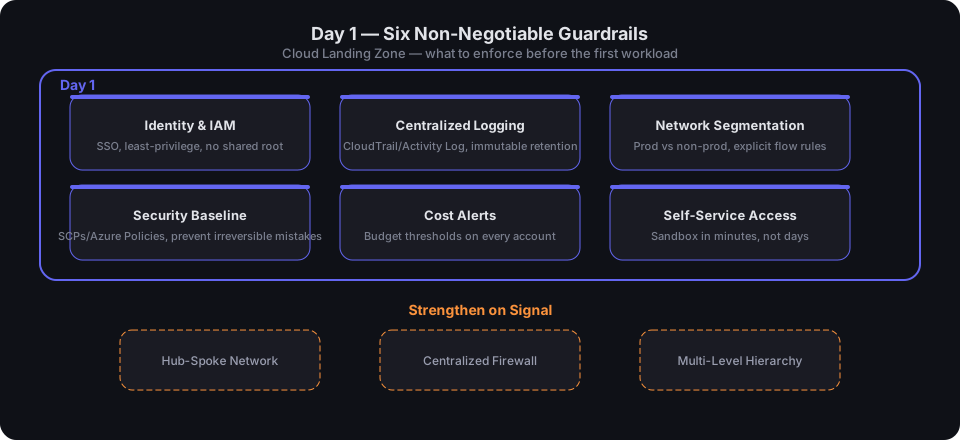
- Identity and IAM. A centralized identity provider, SSO, and least-privilege by default. No shared root accounts, no static keys in a repo.
- Centralized logging. CloudTrail or Azure Activity Log enabled across all accounts, with a retention bucket that nobody can delete.
- Minimal network segmentation. Separation between production and non-production. One VPC or VNet per environment, with explicit flow rules.
- Security baseline. SCPs (AWS) or Azure Policies that prevent irreversible mistakes: public S3 buckets, disabled encryption, resources in unauthorized regions.
- Cost alerts. A budget with alert thresholds on every account. No exceptions.
And a sixth that too many organizations treat as a luxury: minimal self-service access to accounts. A developer waiting 48 hours for a sandbox environment will end up using a personal credit card. That is mechanics, not malice.
Anything not on this list waits for a concrete signal before being added. Hub-and-spoke networking, centralized Azure Firewall, three-level management group hierarchies: these are legitimate architecture decisions. But making them before you have a workload in production is speculation about your future needs. At 3 accounts, the governance overhead of AWS Control Tower has no proportional benefit. AWS Organizations alone, with SCPs and CloudTrail, is enough. Control Tower’s ROI starts at 10 accounts and beyond.
Governance that gets bypassed
Section titled “Governance that gets bypassed”I’ve watched teams spend months designing preventive controls that developers bypassed within the first week. Not out of carelessness. Out of necessity. When governance blocks daily work, people find alternate routes.
The numbers are unambiguous. 41% of employees already install tools outside IT’s radar, according to Gartner, and that figure is projected to reach 75% by 2027. IBM’s 2024 Cost of a Data Breach Report puts the average cost of a breach involving shadow data at $5.27M, 16% more than an incident in a visible environment. Guardrails that block create exactly the risk they are supposed to prevent.
Microsoft defines “self-service with guardrails” as a platform design principle: governance becomes a constraint built into the platform, not an approval process. You don’t request permission to create an account. You create one, and policies apply automatically. The difference between these two models is the delay between intention and action.
Strengthen on signal, not on schedule
Section titled “Strengthen on signal, not on schedule”The natural reflex after laying down the six guardrails is to plan what comes next: “Q2 we add the network hub; Q3 the centralized CSPM.” Comfortable. Also wasteful.
In my experience, the moments when the foundation needs to evolve announce themselves:
- Multiple teams duplicate IAM configurations because self-service doesn’t cover their use case. You are missing a role-vending mechanism.
- Your cost alerts don’t fire when someone activates a NAT Gateway or a PrivateLink endpoint. The thresholds are calibrated to the wrong scope.
- Security findings appear in production that your detective guardrails should have caught in staging. Your policies have gaps.
- Teams create accounts through a parallel process because the official one takes a week. Self-service is insufficient.
Each of these signals justifies a targeted investment. A quarterly roadmap does not. Strengthening the foundation before these signals appear means building for an imaginary problem and delaying the fix for real ones.
Self-service as the measure of success
Section titled “Self-service as the measure of success”Your landing zone succeeds when it disappears from daily friction. Your developers should not know it exists.
Spotify embedded security controls into its Golden PathGolden pathA supported, self-service route that packages an organization’s preferred tools and practices for a common software delivery task. and connected vulnerability ownership to Backstage. Security became ordinary engineering work, not a separate process. Goldman Sachs, in one of the most regulated environments in the world, deployed FastTrack: a self-service platform on AWS with automated guardrails. If an investment bank can push controls into self-service, the “our context is too regulated” argument does not hold.
DORADevOps Research and AssessmentA research program that measures software delivery performance through four key metrics: deployment frequency, lead time, change failure rate, and recovery time.’s 2024 Accelerate State of DevOps Report puts a number on it: developer independence within internal platforms correlates with a 5% improvement in individual and team productivity. The same report warns that a poorly designed platform can temporarily lower throughput. Self-service is not a checkbox. It is an internal product, with users, metrics, and a backlog.
Mia-Platform distinguishes four control mechanisms in platform engineering: paved roads, golden paths, guardrails, and railroads. The progressive landing zone falls under guardrail logic. You set the boundaries, not the path. The team decides how to get from A to B, as long as they stay within limits.
Where to start
Section titled “Where to start”Take your current landing zone, or the one you are designing right now. Check the six guardrails: identity, logging, segmentation, security baseline, cost alerts, self-service. Whatever is missing becomes this week’s priority. Whatever is there but more complex than it needs to be: simplify. If you deployed hub-and-spoke with Azure Firewall for three dev accounts, remove it.
Strip out everything added “just in case” that hasn’t been used yet. Then wait for the signals. Not next quarter. The signals.