Technical Debt Portfolio Reviews: Stop Re-Scoring, Start Deciding
You open the debt register for review. Eighteen items were re-scored, the arguments return, nobody knows what can be funded, and the roadmap remains untouched. I would stop treating the register as the agenda. Bring only the assumptions that changed, and require every selected item to end with a decision.
That is portfolio governance, not backlog grooming.
A backlog tells you what has been recorded. A portfolio review decides whether you will repay, contain, tolerate, or retire a liability in light of what changed around it. The duration, participants, and cadence can vary. The decision logic should not.
A review earns its place only when it changes something
Section titled “A review earns its place only when it changes something”Most technical debtTechnical debtA design or implementation liability that makes a plausible future software change costlier, riskier, or impossible. reviews fail before they start because the expected output is vague. “Review the debt” is not a decision. Neither is “update the priorities.”
You need to define what the forum can change. Can you reserve capacity? Move a roadmap milestone? Accept exposure until a dated event? Stop further investment in a system? Fund decommissioning? Escalate a decision to someone who holds the budget?
If the answer is no, you are preparing a portfolio review, not running one.
The SEI recommendations for managing technical debt call for regular review, explicit trade-offs, roadmap allocation, and metrics interpreted in system context. The same study reports that Google explored 117 candidate metrics and found that no single metric predicted every reported debt category. A scoring model can organize evidence, but it cannot decide which business promise deserves capacity.
I’ve seen technical debt forums spend most of their time debating whether a score should be 7 or 8. The number changes. Nothing else does. Six months later, the affected migration appears as an emergency because nobody connected the score to funding authority or a roadmap trigger.
Set a decision boundary before discussing any item:
| Question | What you need to make explicit |
|---|---|
| What may change? | Treatment, funding, sequence, scope, risk acceptance, ownership, or retirement |
| Who may decide? | The people present, or a named escalation path |
| What constrains the choice? | Capacity, roadmap promises, regulatory dates, and system lifespan |
| What counts as a valid output? | A recorded decision with an owner, consequence, expiry, and trigger |
This is the part that should not change. How you organize the conversation around it is yours to adapt.
Bring changed assumptions, not the full register
Section titled “Bring changed assumptions, not the full register”An inventory is useful for traceability. It is a poor meeting agenda.
Review an item when new evidence could change its treatment. The useful unit of review is not “technical debt item 184.” It is the assumption that no longer holds.
| Changed assumption | Evidence worth bringing | Decision it may change |
|---|---|---|
| Roadmap demand | A feature, market, migration, or customer promise now depends on the affected area | Tolerate or contain may become repay |
| Realized interest | Rework, delay, deployment pain, incidents, or repeated coordination cost has appeared | Exposure or funding may rise |
| System lifespan | Retirement moved closer, or the asset will remain longer than expected | Repay may become retire, or tolerate may become repay |
| Remediation feasibility | A migration path, boundary, replacement, or safe containment option now exists | A previously blocked treatment becomes viable |
| Confidence | Better runtime, delivery, cost, or ownership evidence changed the estimate | The item enters or leaves the portfolio |
The systematic review of technical debt prioritization found no consensus on one universal prioritization method and concluded that the available measures capture only part of the factors used in practice. That is not an argument against discipline. It is an argument for context.
Business context can alter the result. A multiple-case study on aligning technical debt with business objectives found that a business-oriented view changed prioritization compared with a purely technical one. So bring the next product commitment, support deadline, and decommissioning decision into the same evidence set as code quality and architecture.
Some changes also deserve faster attention. Martini and Bosch’s study of contagious architectural technical debt found that certain architecture liabilities can spread and compound across a system. Waiting for a scheduled review makes little sense when a new dependency, duplicated workaround, or blocked delivery stream shows that spread is already happening.
Use a decision sequence, not a meeting script
Section titled “Use a decision sequence, not a meeting script”I do not think you need a universal agenda measured in minutes. You need a sequence that protects the quality of the decision.
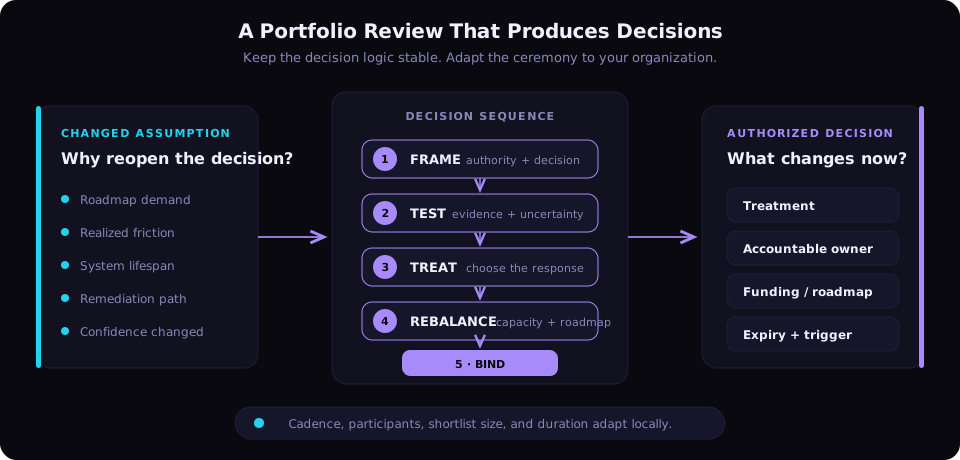
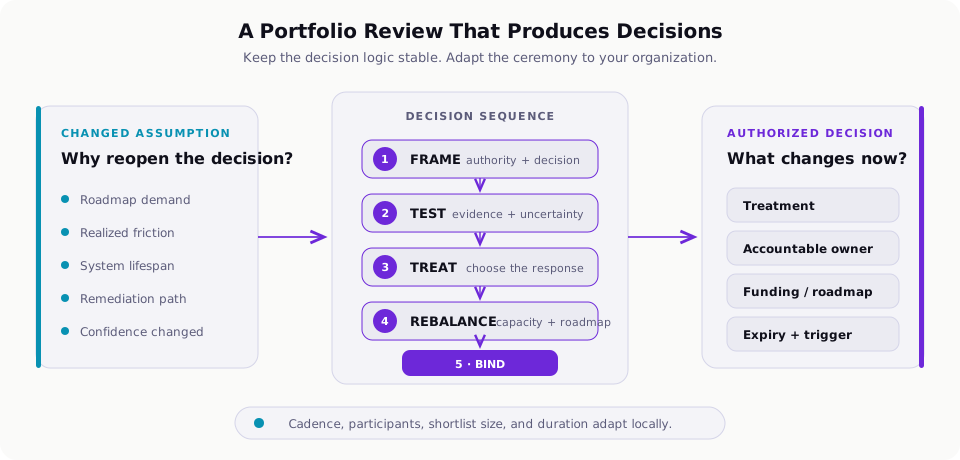
The pattern below is a design choice, not a claim that one ceremony is optimal for every organization.
| Stage | Question | Required output |
|---|---|---|
| Frame | What changed, why is this in front of us, and do we hold the authority to act? | Decision statement or named escalation |
| Test | What evidence supports the changed assumption, what is still uncertain, and what happens if we do nothing? | Evidence summary and confidence |
| Treat | Should we repay, contain, tolerate, or retire the liability now? | Chosen treatment and rationale |
| Rebalance | What capacity, sequence, dependency, scope, or exposure changes across the portfolio? | Funding or roadmap consequence |
| Bind | Who owns the outcome, when does it expire, and what event reopens it? | Owner, expiry, trigger, and decision record |
You can run this sequence inside a roadmap checkpoint, architecture forum, quarterly planning event, product review, or a dedicated session. You can use it continuously for decisions within local authority and reserve a portfolio forum for items that cross products, budgets, or organizational boundaries.
The format is adaptable. The outputs are not optional.
Do discovery before the decision forum. Your pre-read should state the current treatment, changed assumption, evidence, delivery impact, proposed treatment, and authority required. When those inputs are missing, record the gap and assign it. Do not turn the review into an architecture investigation with no decision at the end.
What the portfolio looks like after real decisions
Section titled “What the portfolio looks like after real decisions”Consider four liabilities around checkout-api. The set is small enough to make each treatment visible, but the same logic works with a different scope.
| Item | Before | What changed | Decision after review | Portfolio consequence |
|---|---|---|---|---|
checkout-api / pricing-shared@4.7.2 | Contain | A second market is now committed and needs a different pricing model | Repay | Fund decoupling and sequence it before the Java 17 migration |
checkout-e2e | Tolerate | Feedback p95 rose from 48 to 71 minutes and release windows are being missed | Contain | Split the critical path and reopen repayment if p95 remains above 45 minutes |
legacy-auth-adapter | Repay | All consumers migrated and production traffic has been zero for 30 days | Retire | Remove support, monitoring, patching, and the planned refactor |
admin-tax-validator | Contain | The product now retires in six months with no planned expansion | Tolerate | Accept the constraint until shutdown, prohibit new consumers, and keep a dated owner |
The portfolio changed. That is the point.
Capacity moves from an unnecessary legacy-auth-adapter refactor to the pricing migration that now blocks committed demand. The slow test suite receives a bounded intervention rather than an open-ended rewrite. The tax validator remains imperfect because its remaining product value does not justify more work.
This is why treatment beats priority. “High” does not tell you what to do. “Contain until p95 stays above 45 minutes for two release cycles, owned by the checkout platform lead” does.
Rebalance after the item decisions
Section titled “Rebalance after the item decisions”Item-by-item decisions are not enough. A portfolio can contain four sensible treatments and still exceed your capacity or contradict your roadmap.
After choosing treatments, step back. Ask what the combined decisions do to delivery.
You may find that two repayments depend on the same architects, that containment adds a coordination cost to a product already under pressure, or that retirement removes a dependency and makes another investment unnecessary. This is where portfolio management earns its name.
The original portfolio approach to technical debt management framed the problem as choosing which uncertain liabilities to incur, hold, or repay and when. Your review should therefore compare debt work not only against other debt work, but also against product commitments, reliability work, and retirement choices.
Use delivery evidence to test the portfolio after the meeting. DORADevOps Research and AssessmentA research program that measures software delivery performance through four key metrics: deployment frequency, lead time, change failure rate, and recovery time.’s continuous delivery guidance points to rework, unplanned work, deployment pain, lead time, and value-stream bottlenecks as useful signals. None is a technical debt score. Together, they can show whether the treatment is reducing the friction you intended to reduce. For a practical method that combines workflow telemetry with reported friction, see Developer Experience: How to Measure and Improve It.
Match the review trigger to your decision environment
Section titled “Match the review trigger to your decision environment”Use a periodic review when portfolio funding and roadmap decisions move on a cycle. Use a different trigger when your products replan monthly, a migration program has weekly dependency decisions, or most debt choices sit inside empowered engineering groups.
Research does not justify one universal rhythm. The empirical study of technical debt management across eight software development groups found wide variation in identification, monitoring, communication, and remediation. The systematic review of prioritization approaches found continuous, sprint-linked, and one-off approaches, while many publications gave no explicit timing guidance.
Choose the trigger that matches where decisions happen:
| Review mode | Use it when |
|---|---|
| Continuous local decisions | The owner controls the capacity and the consequence stays within one product or platform |
| Roadmap-linked review | New commitments, migrations, or market plans change demand on the affected systems |
| Periodic portfolio reset | Funding and cross-organization trade-offs need a recurring governance point |
| Event-driven review | An incident, end-of-support date, repeated delay, acquisition, or spreading dependency invalidates an assumption |
NISTNational Institute of Standards and TechnologyA United States federal agency that develops cybersecurity standards, guidelines, and vulnerability data infrastructure.’s guidance on prioritizing cybersecurity risk and aggregating risks into an enterprise portfolio offer a useful analogy: identify the scenario, choose a response in light of enterprise objectives, record ownership and cost, then aggregate the consequences at the level where trade-offs can be made. Technical debt is not cybersecurity risk, but the governance mechanics transfer well.
Close the decision so it can expire
Section titled “Close the decision so it can expire”A decision record should let someone reconstruct why you chose the treatment and know when that choice is no longer valid.
| Record area | Minimum content |
|---|---|
| Decision | Date, accountable owner, old treatment, new treatment, and rationale |
| Evidence | Changed assumption, supporting observations, confidence, and unresolved gap |
| Commitment | Capacity, roadmap, scope, dependency, or accepted exposure |
| Revisit | Expiry date, event trigger, and authority required next time |
Do not write “review next quarter” unless the quarter itself changes something. Use a trigger tied to the assumption: second market committed, support ends, p95 crosses the threshold, traffic reaches zero, the migration path is proven, or a containment boundary gains another consumer.
Pick the next roadmap or investment checkpoint where technical debt already affects a choice. Bring only the liabilities whose assumptions changed and whose consequences the participants can alter. Run the decision sequence, record the commitments, and check whether the roadmap or capacity allocation moved.
If nothing changed, stop calling it a portfolio review.
Article series
Technical Debt as a Decision System
Explore every resource in this series, whatever its format.