VEX: Documenting "Not Exploitable" Without Turning Security into a Checkbox
Everyone tells you that when a VEXVulnerability Exploitability eXchangeA security advisory that communicates whether vulnerabilities affect a specific product and why. says “not exploitable,” you can suppress the finding and move on. They’re wrong.
I’ve watched teams do exactly this. A supplier publishes a known_not_affected status, someone marks the CVECommon Vulnerabilities and ExposuresA standardized identifier for a publicly disclosed cybersecurity vulnerability. as resolved, and the finding drops off the dashboard. Three months later, a configuration change reintroduces the exposure. Nobody remembers the original assessment. That’s not security. That’s a checkbox.
A VEX is an attributable statement about a named product. It is not independent proof of what is deployed, configured, exposed, or reachable in your environment — the same gap that makes SBOMs insufficient on their own. The useful outcome is smaller and more reviewable: for one finding, preserve the VEX assertion and its scope, compare it with local evidence, name an owner, and decide whether to retain, investigate, or deprioritize. If a link is missing or contradictory, keep it unknown.
What a VEX statement actually says
Section titled “What a VEX statement actually says”The CSAF VEX profile (Committee Specification Draft 02, 25 February 2026) exists to communicate whether and why a particular product is affected by a vulnerability. CSAFCommon Security Advisory FrameworkAn OASIS standard for machine-readable security advisories, used as one of the formats for publishing VEX statements. VEX supports four product-status values: fixed, known_affected, known_not_affected, and under_investigation. A VEX profile document must include product and vulnerability information plus one of those status groups. unknown exists in the wider CSAF status vocabulary but does not satisfy the VEX profile requirement.
The format makes an assertion auditable. It does not validate the assertion in your environment.
For known_not_affected, CSAF requires an impact statement for every affected product entry, either a machine-readable flag or a human-readable explanation. Preserve the exact explanation rather than reducing it to a yes/no label.
The CISACybersecurity and Infrastructure Security AgencyThe United States federal agency responsible for cybersecurity guidance, vulnerability coordination, and critical infrastructure protection.-hosted VEX status-justification guidance makes the practical point: a VEX status should inform your assessment, not end it. And the absence of a VEX is not evidence that a product is affected. CISA’s issuance guidance notes that issuing VEX information is a business decision for most suppliers.
The evidence-to-decision path
Section titled “The evidence-to-decision path”This is a Kurio Nova operating model — part of the framework from From SBOM to Actionable Signal — synthesized from the sources below. It is not a CSAF requirement, a compliance framework, or an automated suppression rule.
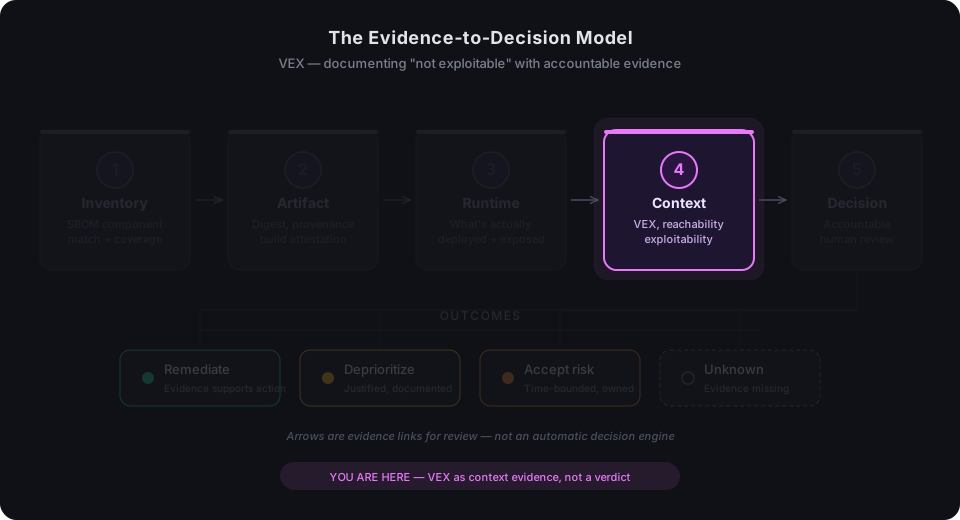
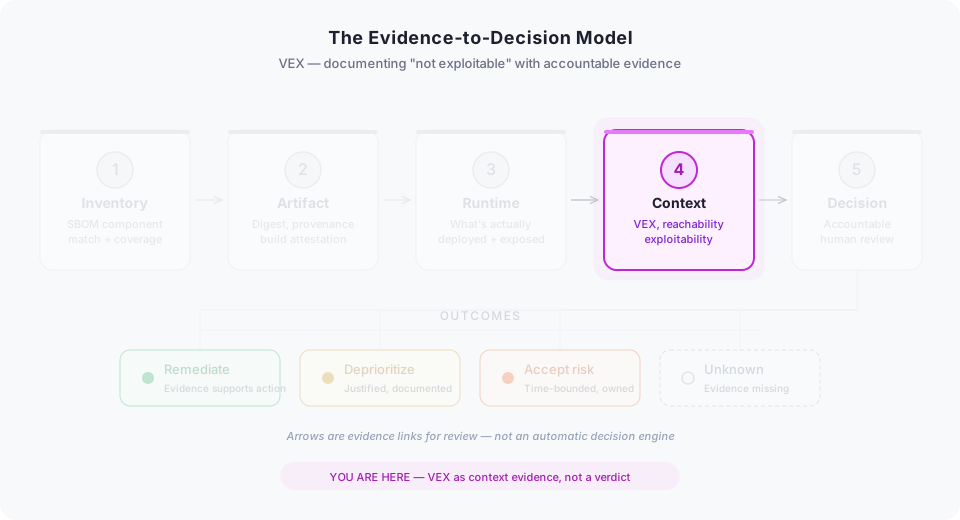
The left side of the diagram covers a product-status statement. The middle covers your environment. Neither side proves the other. That separation matters most when a supplier uses a broad product family, your deployment runs a fork or custom build, or a mitigation depends on configuration.
Read the justification as a bounded claim
Section titled “Read the justification as a bounded claim”The CSAF specification defines five machine-readable “not affected” justification flags. They are not interchangeable reasons to mark something safe.
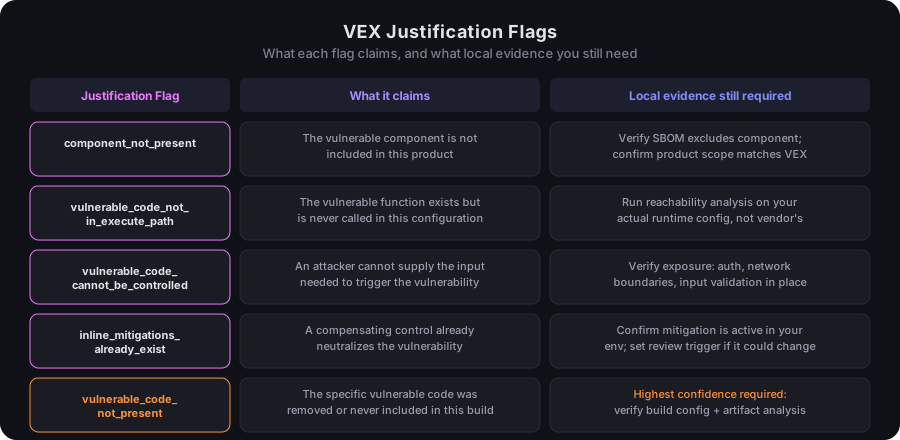
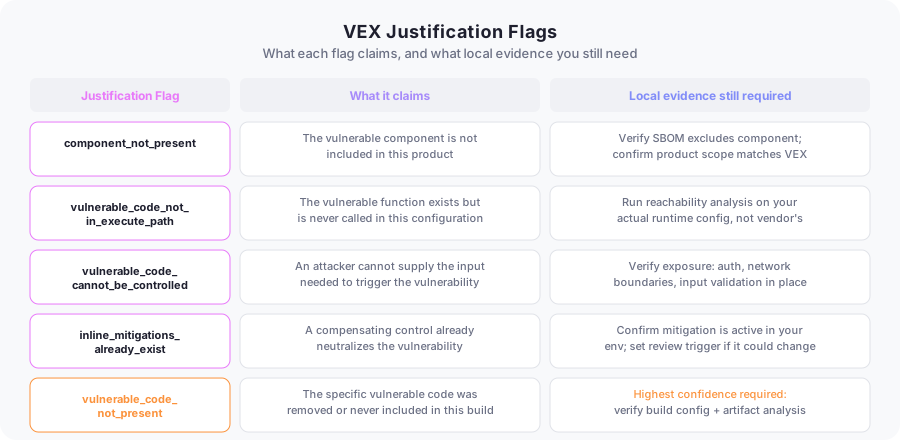
| Justification | What it claims about the named product | Evidence to revisit locally |
|---|---|---|
component_not_present | The affected component is absent. | Product/version and artifact inventory; a different build may include it. |
vulnerable_code_not_present | The component is present but the vulnerable code is absent. | Exact source/build lineage and product version. |
vulnerable_code_not_in_execute_path | The code is not reachable through execution in the anticipated product state. | Configuration, enabled features, reachability method, coverage, and changed use cases. |
inline_mitigations_already_exist | Built-in controls prevent adversary leverage. | The mitigation’s enabled state, configuration, and any relevant threat assumptions. |
vulnerable_code_cannot_be_controlled_by_adversary | The producer’s anticipated conditions do not let an adversary control the code. | Exposure, input paths, identity boundaries, and changed deployment conditions. |
Each flag is bound to identified products or product groups in CSAF. A valid product-family statement may still require work to confirm that the exact product and version you run belongs to that scope. A human-readable impact statement can also be valid, so do not reject a VEX because it lacks one of these flags.
When a VEX justification rests on reachability, treat the analysis method’s coverage as a ceiling on your confidence. A study on Java/JVM dependency reachability showed this, but the finding is bounded to that setting, not a universal measure.
Keep the VEX claim separate from deployment evidence
Section titled “Keep the VEX claim separate from deployment evidence”A VEX establishes who made a product-status assertion, with what version and scope. It does not show which artifact is running right now.
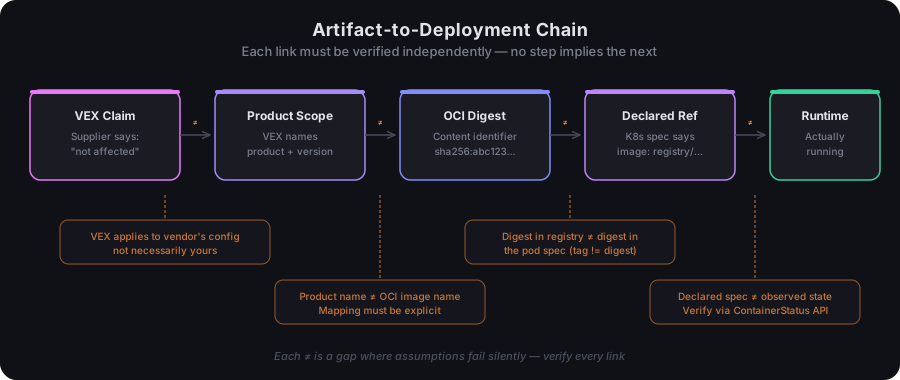
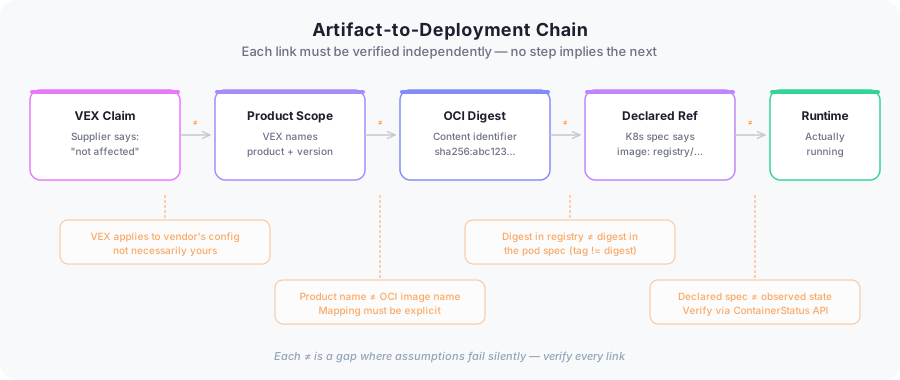
For a containerized product, an OCI descriptor digest is a content identifier that can join to exact bytes. It does not establish the current workload, configuration, exposure, or safety. In Kubernetes, the ContainerStatus API notes that a runtime image identifier can differ from the image reference declared in the Pod specification. Retain both a declared reference and a dated runtime observation where relevant. Building a DevSecOps Evidence Chain walks through how to join these observations into a reviewable record.
I’m not telling you to collect every possible signal before acting. I’m saying: name which signal supports which conclusion — and which question remains open.
A minimal VEX review record
Section titled “A minimal VEX review record”| Field | Example record |
|---|---|
| Finding | CVE-2024-38816 in payments-gateway |
| VEX source | Acme Networks, ACME-SA-2026-07, version 1.2, released 2026-07-28 |
| Product scope | Acme Gateway 4.2.1; local package/version match recorded separately |
| Status and rationale | known_not_affected; inline_mitigations_already_exist |
| Artifact/deployment | OCI image digest recorded; production workload observation dated 2026-08-03 |
| Local context | Mitigation configuration captured; external exposure review incomplete |
| Disposition | investigate, not suppression |
| Owner and review date | Service owner; re-review by 2026-08-10 |
| Reopening events | VEX revision, image/configuration change, new exposure evidence, or conflicting analysis |
| Evidence links | Raw VEX, product mapping, digest record, deployment observation, configuration review |
You should be able to hand this record to someone else and have them reconstruct why you considered the VEX applicable, which assumptions remain open, and what triggers a re-review.
When a VEX should not close the finding
Section titled “When a VEX should not close the finding”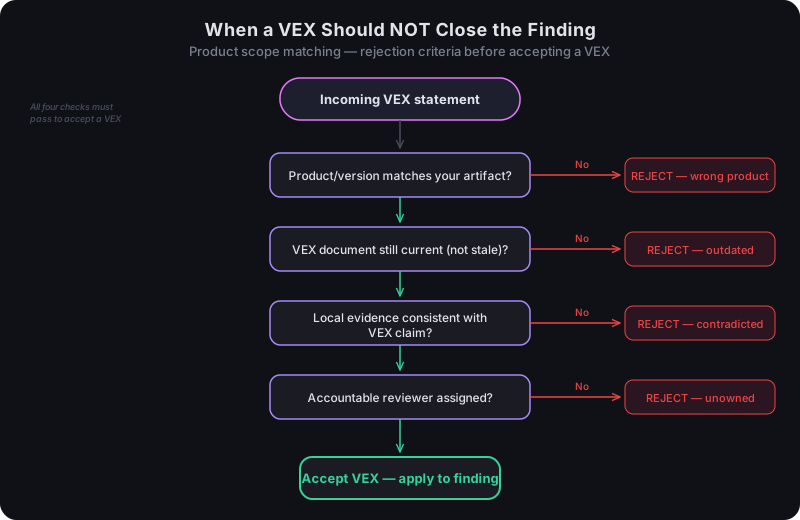
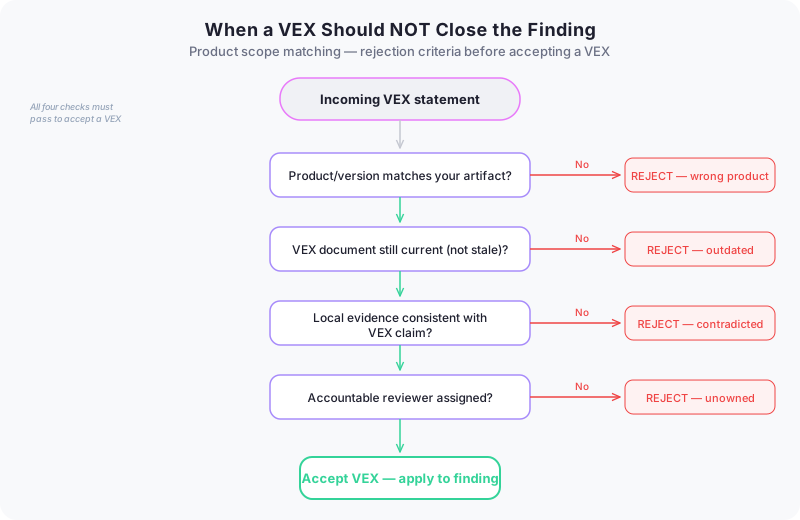
- The product or version does not match. A justification for a supplier product family is not evidence for a fork, repackaged component, or a different version.
- The document is unresolved or incomplete.
under_investigation, a missing impact explanation, or a missing product scope leaves the decision open. - The evidence is stale. CSAF tracking includes identifiers, release dates, version, and revision history. A released version is not modified in place, so a new version can change the decision context.
- Local conditions contradict the rationale. A mitigation-dependent claim needs review when configuration, exposure, artifact, or deployment changes.
- Reachability evidence is too narrow. An analysis result without its method, language/runtime scope, and coverage should not carry a broad “not exploitable” conclusion.
A review checklist for one finding
Section titled “A review checklist for one finding”- Retain the issuer, role, document ID, status, version, release dates, revision history, vulnerability ID, product scope, and exact impact statement.
- Match that scope to your product and version; record ambiguity rather than inferring equivalence.
- Record artifact identity and a dated deployment observation separately when they matter to applicability.
- State local configuration, exposure, and reachability evidence, including method and coverage.
- Have an accountable person select and date a local disposition with a review date and explicit reopening events. Missing or contradictory evidence stays as
investigateorunknown.
What to do next
Section titled “What to do next”Take the next VEX-backed finding in your queue. Build the review record before you touch its priority or suppression state. If the finding arrived as a critical CVE, Responding to a Critical CVE provides the per-service routing checklist. If someone else cannot reconstruct your reasoning from the raw assertion, local evidence, and reopening conditions alone, the record is not done.
Article series
From SBOM Findings to Defensible Decisions
Explore every resource in this series, whatever its format.
- articleWhy Your SBOM Does Not Protect You (and What Is Missing)
- articleFrom SBOM to Actionable Signal: Which Vulnerabilities Should You Actually Fix?
- guideBuilding a DevSecOps Evidence Chain: SBOM, Provenance, Deployment, and VEX
- articleResponding to a Critical CVE Without Triggering a Flood of False Positives
- articleVEX: Documenting "Not Exploitable" Without Turning Security into a Checkbox
- articleWhat the Cyber Resilience Act Changes for Software Vulnerability Management